


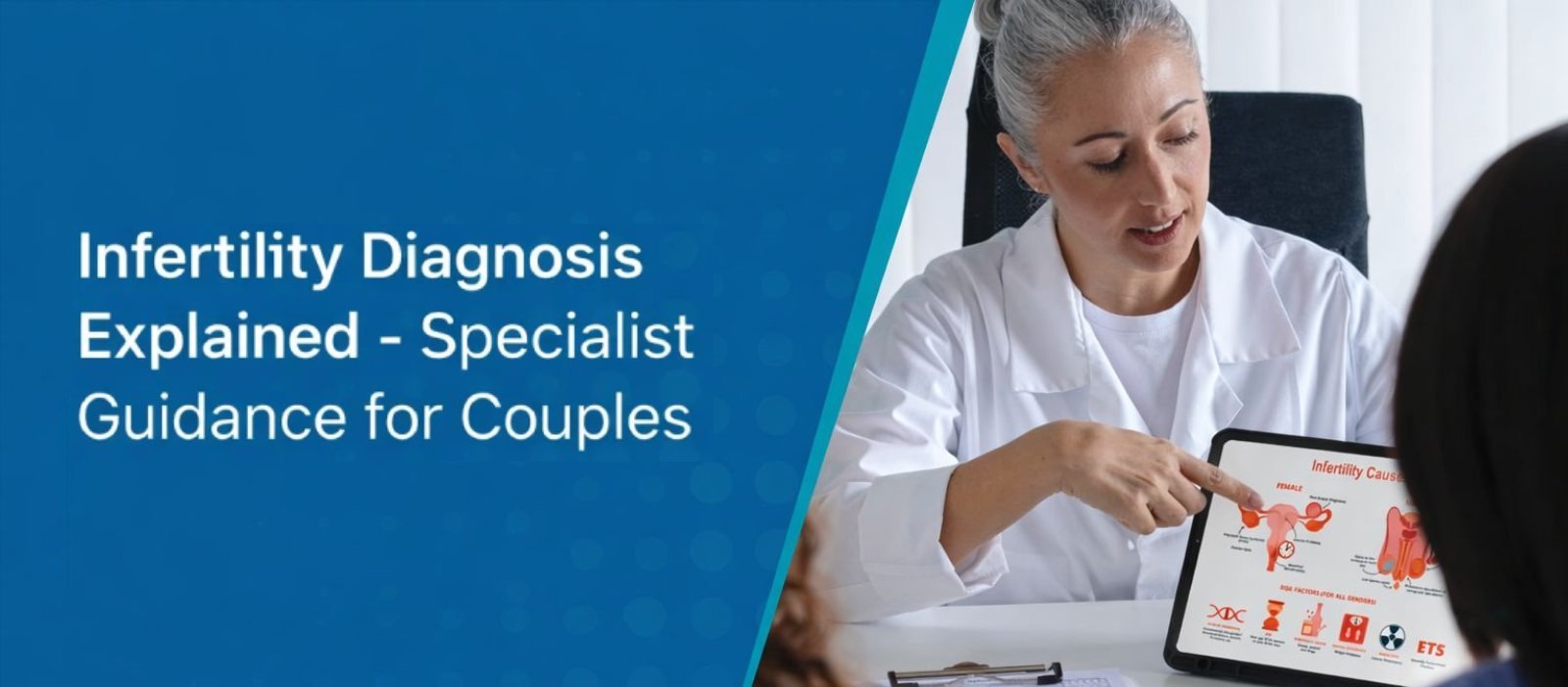
Infertility Diagnosis Explained – Specialist Guidance for Couples
Key Takeaways
- Infertility is more common than you think, with every 1 in 6 people experiencing it in their lifetime. Infertility is treatable and nothing to be ashamed of!
- If you are under 35 and have been trying to conceive for over 12 months, it is the right time to consult a fertility specialist. If you are over 35 years of age, it is best to consult an expert after 6 months of trying.
- If everything seems normal in your reports, that does not mean there’s no solution for you. Unexplained infertility is common, and with the right guidance, you can conceive.
- A healthy lifestyle is essential for successful conception and a healthy pregnancy. So, focus on your physical and mental well-being.
- Dr. Rajeev Agarwal, an IVF specialist, offers world-class fertility solutions backed by compassion, cutting-edge technology, and evidence-based care.
In This Article
- Key Takeaways
- What Is Infertility?
- When Is The Right Time To See A Fertility Specialist?
- How Is Infertility Diagnosed In Couples?
- What If the Tests Show Nothing Wrong?
- Understanding Your Results & Next Steps
- The Role Of A Fertility Specialist In Your Journey
- Frequently Asked Questions
Infertility affects around 15% of couples globally, which is around 48.5 million couples.
Parenthood is the dream of almost every couple in the world. So, challenges in conception and infertility can feel distressing.
When pregnancy doesn’t happen as expected, it’s natural to feel uncertain about what comes next. At this stage, all you need is the right guidance. This is why Dr. Rajeev Agarwal, a fertility specialist with 25+ years of experience, has addressed everything you need to know about infertility diagnosis for couples.
In this guide, you will understand male and female infertility, step by step infertility diagnosis process, infertility evaluation before IVF, and the right steps that you should take towards achieving parenthood.
What Is Infertility?
Infertility basically means the inability to conceive a child. Scientifically, if a couple is unable to conceive after 12 months of regular, unprotected intercourse, it is considered infertility.
As per the World Health Organisation, 1 in every 6 individuals in the reproductive age experience infertility in their lifetime, so there’s nothing to be embarrassed about. Despite being stressful and upsetting, infertility is treatable in most of the cases.
- Female Infertility
Female infertility is when a woman is unable to conceive due to various reasons.
Female infertility causes include:
- Ovulation disorders
- Blocked fallopian tubes
- Endometriosis
- Uterine abnormalities
- Age-related factors
- Hormonal imbalances
- Male Infertility
Male infertility is actually quite common and often under-recognized. Since it is closely related to lifestyle factors, male infertility diagnosis is easier and more easily treatable.
Male infertility causes include:
- Low sperm count
- Poor sperm motility or shape
- Hormonal issues
- Genetic factors
- Lifestyle influences
When Is The Right Time To See A Fertility Specialist?
Conception can take some time, and sometimes, all you need is to improve your lifestyle, reduce stress, and keep trying. However, you must visit an infertility specialist if:
- You are under 35 and have been unable to conceive after 12 months of regular unprotected intercourse
- You are 35 or older and haven’t conceived after 6 months
- You have irregular menstrual cycles, PCOS, endometriosis, or thyroid issues
- There is a history of miscarriages
- You want guidance on fertility preservation or family planning
How Is Infertility Diagnosed In Couples?
Diagnosing infertility combines detailed medical history, advanced diagnostics, and personalised assessment, because every couple is different. This is why Dr. Rajeev Agarwal approaches infertility treatment and pregnancy problems as a holistic and personalised process, using evidence-based advanced care. You can also book an online consultation with a gynaecologist to understand the first steps of your diagnosis.
- A Couple‑Centred First Consultation
Dr. Rajeev Agarwal offers a couple-centred first consultation, which focuses on understanding the real issues being faced by the couple. This step is essential for designing a personalised infertility treatment for them.
- Female Fertility Assessment
Female infertility diagnosis focuses on three key aspects: ovulation, fallopian tube health, and uterine condition.
An infertility diagnosis in females can be done through various tests, such as:
- Egg quality test (AMH/AFC)
- Fertility hormone tests (check FSH, LH, AMH, and progesterone)
- Ultrasound follicular monitoring
- Assessment of ovarian reserve
- Male Fertility Assessment
Male infertility contributes to nearly 40–50% of infertility cases, making evaluation equally important.
Fertility test for men:
- Semen Analysis
- Hormonal evaluation
What If the Tests Show Nothing Wrong?
Many times, couples undergo an infertility diagnosis only to find out that all the tests are normal.
If the results come back normal for both partners, this is known as “Unexplained Infertility”.
Many couples fear that unexplained infertility means there is no problem, or worse, no solution. But understanding the infertility meaning is important – infertility simply refers to the inability to conceive after a certain period of regular, unprotected intercourse. In cases of unexplained infertility, it means that routine investigations have not identified a clear cause.
This situation is more common than many couples realise, and it can still be treated successfully. Many couples with normal reports go on to conceive with guided treatment.
Understanding Your Results & Next Steps
Honestly, you just need to place your faith in your fertility specialist. They will help you understand the results and guide you through the next steps of the process. Since this process is different for each couple, the next steps are also hyper-personalized for you.
Preconception care and fertility support services can help you achieve parenthood.
The Role Of A Fertility Specialist In Your Journey
The role of a fertility specialist is to guide you at every stage of your parenthood journey.
From identifying the exact cause of infertility and giving personalised infertility help to providing advanced fertility treatments like IVF, a fertility expert provides complete guidance to couples.
Beyond medical care, fertility expert Dr. Rajeev Agarwal provides emotional support and clear guidance, helping you make informed decisions and improving your chances of achieving a successful pregnancy.
Frequently Asked Questions
1. How long does an infertility diagnosis take?
Most basic fertility evaluations are completed within 2 to 4 weeks. Some tests are cycle-specific, so timing may depend on your menstrual cycle. Advanced tests, if required, may take slightly longer. You should be mentally prepared that these tests may take up to a month or more.
2. Do both partners need to be tested for infertility?
Yes, definitely. Both male infertility and female infertility can be equally responsible if you are unable to conceive. So, both partners must be tested for infertility.
3. Are infertility tests painful or invasive?
Most tests, such as blood tests, ultrasound, and semen analysis, are simple and minimally uncomfortable. So, you don’t have to worry about pain and discomfort. A few procedures, like HSG, may cause mild temporary discomfort. But overall, an infertility diagnosis is not a painful process.
4. How soon can treatment start after diagnosis?
Starting the treatment mainly depends on which partner is infertile and what steps need to be taken. In the case of females, treatments mostly start with the next cycle. For men, treatments might start right after diagnosis.
Services By Concern
PCOS Management | Period Pain Relief Solutions | Menopause Wellness Programs | Fibroid Treatment Solutions | Urinary Health Services | Healthy Aging Programs | Sexual Pain Relief Therapy |
Services By Procedure
Women’s Health Check | Vaginismus Therapy | Urinary Laser Therapy | Laparoscopic Surgery | Hysteroscopic Procedure |
Popular Blogs
Understanding The Role Of Genetics In Ivf Success | Battling Blood Sugar During Pregnancy | How Sleep Affects Hormonal Balance & Fertility In Women | Birth Control Pills For Pcos: How Long Should You Stay On Them? | Can Ovarian Stimulation Affect Your Next Period Cycle? |